
• Link to Facebook
  • Link to X
  • Link to Instagram
  • Link to LinkedIn
  • mail icon info@ramgrouplv.com
  • phone icon 702-363-4788
Ram Real Estate
  • Our Properties
    • Hughes Plaza West
    • Mission Paseo Plaza
    • Sahara Towne Center
    • The West Robindale Acute Care & Rehabilitation Facility
    • Care/Rehab Center at W. El Dorado Lane
  • Available Spaces
    • CLASS “A” OFFICE SPACE
    • Retail Spaces
    • MEDICAL
  • Our Services
  • About Us
  • Our Team
  • News
  • Contact Us
  • Menu Menu

Commercial Property Management Fees in Las Vegas: What Owners Pay and What Each Fee Covers

Published national fee guides put commercial property management fees at roughly 2% to 7% of collected rent, depending on property type, with leasing, renewals and construction oversight often billed separately. Fees vary by property type, size, services and contract structure, and the percentage on a proposal is rarely the whole cost. In a year with a new lease, a renewal and a tenant build-out, you will also pay one-time fees on top of the annual management fee.

This guide breaks down every fee type you will see on a Las Vegas management proposal, what each one covers, which costs your tenants reimburse through CAM, and what a full year can actually cost on a sample center. The published ranges below are national, not Las Vegas specific. They come from two online industry guides, not from a survey of Las Vegas managers and not from RAM’s pricing, so they are not local averages. Use them as a reference when you read a proposal, not to predict one.

If you are comparing managers, start here.

Commercial Property Management Fees: What Each One Covers

The management fee is the base. Everything else is priced on top of it. Here is what appears on a typical proposal, what it pays for, and the published range where one exists.

Fee What it covers How it is usually charged Published national range (not Las Vegas specific)
Management fee Rent collection, tenant communication, vendor oversight, bookkeeping, monthly owner reports, property inspections Percent of collected rent, sometimes with a monthly minimum Office 3% to 6%, retail 4% to 7%, industrial 2% to 4% (Core Insights Review)
Flat or minimum fee The same services, billed as a fixed amount or a floor Fixed monthly amount $500 to $5,000 per month (HelloData)
Leasing commission Marketing the space, showing it, negotiating and closing a new lease Varies by agreement, often tied to base rent over the lease term No published range found. Negotiate in writing.
Renewal fee Negotiating and papering a renewal Varies by agreement No published range found. Negotiate in writing.
Construction or project management Overseeing tenant improvements and capital projects Varies by agreement, often tied to project cost No published range found. Ask for the percentage and the cost threshold.
Setup fee Onboarding, tenant file transfer, accounting setup One time Not consistently published
Termination fee Ending the contract early Varies by agreement Not consistently published
Vendor markup Margin added to maintenance and repair invoices Percent of invoice 10% to 20% when uncapped (HelloData; Core Insights Review)

Management fee ranges by property type. A 2026 fee guide from Core Insights Review, which compiles rates published by several firms and does not name a source for each tier, lists office at 3% to 6%, retail at 4% to 7% and industrial at 2% to 4% of collected rent. Within retail, it puts anchored centers at 4% to 5% and strip centers at 5% to 6.5%. Within office, Class A runs 3% to 4% and Class C 5% to 6%. In that guide, smaller and higher-turnover properties sit toward the higher end. These are national figures, not verified Las Vegas pricing.

A wider range for all property types. HelloData’s fee guide gives 4% to 12% of gross monthly rent, or $500 to $5,000 per month on a flat basis. It does not cite a survey, so treat it as a rough outer bound.

Leasing, renewal and construction fees are the gap in the public data. We could not find a published range for any of them, which is itself a finding. These fees are negotiated deal by deal. Get the formula in writing, and compare it with what local brokers charge for the same work.

Vendor markups are worth asking about. HelloData’s guide lists a 10% to 20% markup on maintenance and repairs, and Core Insights Review says uncapped markups routinely add 10% to 20% to maintenance invoices. Core Insights Review also recommends capping markups at 5% and itemizing them on every invoice. That is published guidance, not an industry standard. Ask whether your agreement allows markups, how they are disclosed and what they cover, so you can tell whether they overlap with the management fee.

What You Pay vs. What Tenants Reimburse Through CAM

Your tenants’ leases decide how much of the management fee comes back to you. In a multi-tenant retail or office property, common area maintenance (CAM) charges let the owner recover shared operating costs from tenants, usually split by each tenant’s share of the building. Many leases list the management fee as a recoverable item. Others cap it, or leave it out.

As a general pattern, and subject to each lease:

  • Often included in CAM, if the lease allows: the management fee (up to any cap in the lease), common area utilities, landscaping, parking lot maintenance, security and shared-area janitorial.
  • Often excluded from CAM, depending on the lease: leasing commissions, renewal fees, tenant improvement costs and capital replacements. Recoverability depends on each lease’s CAM language and its list of exclusions.

Vacancy matters too. Tenants usually pay their pro-rata share, so the owner often covers the share tied to vacant suites. In a center that is 90% occupied, tenants’ combined pro-rata shares add up to 90%, so the owner could recover about 90% of the management fee if every lease makes it fully recoverable. A cap in the lease, such as a ceiling of 3% of gross revenue, can cut that recovery further.

Check three things before you sign a management agreement:

  1. Does each lease allow the management fee to be passed through, and is it capped?
  2. Does the fee basis in your management agreement match what the leases let you recover? If you pay 5.5% on all collected receipts but a lease caps recovery at 3% of base rent, you absorb the difference.
  3. Who prepares the year-end CAM reconciliation, and is that work included in the fee?

The Nevada Real Estate Division publishes a trust fund accounting guide for brokers, which says brokers who manage property for clients must keep property management accounts separate from other trust accounts, maintain owner and tenant ledgers, and reconcile monthly. The guide is a general reference and does not address commercial property specifically, and requirements depend on the arrangement, so ask your manager how funds are held and how often you receive statements. Our post on property management contracts covers scope of work, reimbursed expenses and termination terms in more detail.

 

A Worked Example: One Year on a Neighborhood Retail Center

The management fee is an annual cost, while leasing, renewal and construction fees are one-time charges tied to specific leases and projects. The example below uses illustrative assumptions. They are not verified market rates, not RAM Group pricing and not a quote. Only the 5.5% comes from a published national range (the strip center band of 5% to 6.5%). The leasing, renewal and construction percentages are placeholders to show the method. Because the one-time fees are priced on multi-year lease values or project costs, the example keeps them separate from the annual management fee and does not combine them into a single percentage of annual rent.

Assumptions:

  • Neighborhood retail center, 90% occupied, $600,000 in collected rent for the year
  • Management fee: 5.5% of collected rent
  • One new 5-year lease: 2,000 sq ft at $2.10 per sq ft per month, with a leasing commission of 4% of total base rent (assumed)
  • One 3-year renewal: 2,500 sq ft at $2.00 per sq ft per month, with a renewal fee of 2% of renewal rent (assumed)
  • One tenant build-out of $120,000, with a construction management fee of 5% (assumed)
Fee Type Calculation Cost
Management fee Annual, recurring 5.5% of $600,000 in annual collected rent $33,000 per year
Leasing commission One time, new 5-year lease 4% of $252,000 in base rent over 5 years $10,080
Renewal fee One time, 3-year renewal 2% of $180,000 in rent over 3 years $3,600
Construction management One time, $120,000 build-out 5% of $120,000 $6,000
Total one-time fees One time Sum of the three one-time fees $19,680

In a year when all three events happen, the owner pays $33,000 in management fees plus $19,680 in one-time fees, or $52,680 in total. In a quiet year, the cost is the $33,000 management fee, or $2,750 a month. The one-time fees are not annual rates, so do not read $52,680 as a percentage of that year’s rent. Ask your manager to model both kinds of year.

How much comes back through CAM depends on the leases. These two cases assume the center is 90% occupied, so tenants’ pro-rata shares total 90%. They also assume gross revenue equals the $600,000 in collected rent, and that the leases let the owner pass the management fee through, either in full or up to the cap:

Lease terms How it is calculated Recovered from tenants You absorb
Fee fully recoverable 90% of the $33,000 fee $29,700 $3,300, which is the 10% tied to vacant space
Recovery capped at 3% of gross revenue A cap of 3% of $600,000 is $18,000. Tenants pay 90% of that cap. $16,200 $16,800, which is $33,000 minus $16,200

The leasing, renewal and construction fees are not in that table because many leases exclude them from CAM, though that depends on the lease. Same manager, same fee, and a $13,500 difference in what you carry.

Watch the vendor line too. As an illustration with assumed numbers, if the center has $60,000 in annual maintenance invoices, a 10% markup adds $6,000, while a 5% markup adds $3,000.


Questions to Ask Before You Sign

  • What is the fee a percentage of: base rent, collected rent, or gross receipts including CAM and late fees?
  • Is there a monthly minimum, and does it apply when the center is partly vacant?
  • What is the leasing commission formula for new leases, and who is paid when a broker is involved on the tenant side?
  • What do renewals cost, and is the fee the same for a 1-year and a 5-year renewal?
  • At what project size does a construction management fee start, and what percentage applies?
  • Do you mark up vendor invoices? If so, by how much, and is there a cap?
  • Are there setup, onboarding or termination fees, and how many days’ notice does the contract require?
  • Which services are included in the base fee and which are billed extra, such as year-end CAM reconciliation, lease audits and insurance claims?
  • Can I see a sample monthly owner report and a sample CAM reconciliation?

Get the answers in the management agreement, not in an email. Our guide to property management contracts lists the clauses worth reading twice.
 

Frequently Asked Questions

How much do commercial property managers charge in Las Vegas?

Published national guides put the management fee at roughly 2% to 7% of collected rent for office, retail and industrial property, depending on property type, size, services and contract structure. We did not find verified Las Vegas pricing, so treat those figures as a reference, not a local average. Leasing, renewal and construction fees may be billed separately. Compare written proposals and what each one includes.

Is the property management fee a percentage of rent or a flat fee?

Both exist. HelloData’s guide lists a flat fee range of $500 to $5,000 per month alongside percentage fees. Which structure applies depends on the property and the agreement, so compare written proposals.

Can I pass the management fee to my tenants?

Sometimes, through CAM, if the lease allows it. Some leases cap the amount or exclude it. Review the lease language before you assume the fee is recoverable.

Are leasing fees included in the management fee?

Often not. Leasing commissions, renewals and construction oversight may be separate line items, so check what the proposal includes.

What do published guides say about fees for a small retail center?

One published national guide puts strip centers at about 5% to 6.5% of collected rent. That is not verified Las Vegas pricing. Compare written proposals, including the services each one covers and the all-in cost for a full year.

Talk to RAM Group About Management

If you own a commercial property in Las Vegas and want to talk about management, contact RAM Group, call 702-363-4788.

RAM Group has more than 125 years of combined commercial real estate experience, led by principal and broker Jeff Susa. Our properties include Mission Paseo Plaza and Hughes Plaza West. Our office is at 3275 S Jones Blvd Suite 105, Las Vegas.


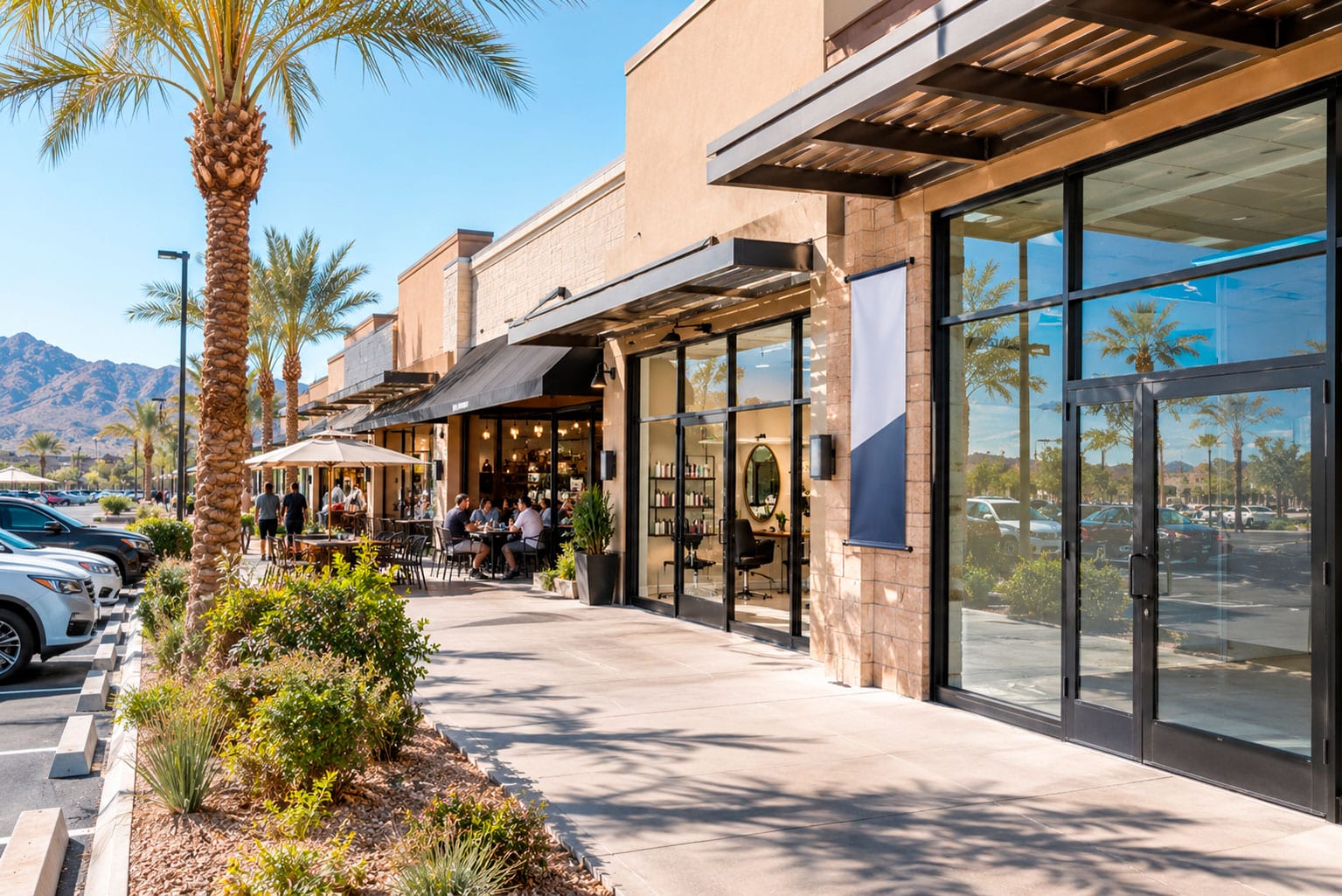
https://ramgrouplv.com/wp-content/uploads/2026/10/Afternoon-mall.jpg 940 1670 Michael Torres https://ramgrouplv.com/wp-content/uploads/2019/06/ram-logo-new.jpg Michael Torres2026-10-13 11:26:362026-10-13 11:26:36Commercial Property Management Fees in Las Vegas: What Owners Pay and What Each Fee Covers

What Class A Office Space Really Costs in Las Vegas: Rent, Operating Expenses, TI and Parking

The rent on a Class A listing is not what you will pay. Class A office space rent in Las Vegas depends on three things the quoted rate hides: how the lease handles operating expenses, how much of your build-out the landlord pays for, and what parking costs. Two offers that look $0.30 apart per square foot can end up $150 apart per month, or the other way around, once those pieces are counted.

This guide runs illustrative numbers on a 3,000 sq ft suite so you can compare offers on the same footing. The figures are assumptions, not quotes. If you still need to know what makes a building Class A, read our guide to what tenants should look for in Class A office space first. This post covers cost only. For the building itself, see our Class A office space for lease page.

What Class A Office Rent Looks Like in Las Vegas Right Now

Check the unit before you compare anything. Las Vegas office rent is quoted per square foot per month in some listings and per square foot per year in others. A $3.15 rate per month is $37.80 per year. Mixing the two is an easy way to misjudge an offer.

Class A typically leases at a premium to the market average. TenantBase puts average Las Vegas office asking rent at about $21.08 per square foot (the report does not say whether that is a monthly or annual figure, so treat it as a rough reference and do not compare it directly with the monthly rates in this guide), and notes that desirable Class A space continues to lease quickly at a premium. For reference, RAM’s Class A office page lists pricing for Hughes Plaza West starting at $3.15 per square foot per month on a full service gross basis, or about $37.80 per year. That is a published starting rate, not a confirmed offer. RAM’s Hughes Plaza West property page currently lists no available spaces, so contact RAM for current availability and pricing.

The market may give you some room to negotiate. CBRE’s Q3 2026 Las Vegas office report says overall Las Vegas office vacancy increased modestly to 11.6% in the third quarter of 2026 (still below the level of a year earlier), net absorption for the quarter was negative 84,000 sq ft, and there were no projects under construction and no deliveries. The report gives overall market figures, not Class A-specific data. Vacancy at that level can give tenants some room to negotiate concessions, though terms depend on the building and the suite.

Class A Office Lease Types: Full Service vs. Modified Gross

Full service gross usually means one monthly number covers base rent plus most of the building’s operating costs, such as property taxes, insurance, common area upkeep and often utilities and janitorial. What is included varies by lease, so read the operating expense and services clauses. Modified gross means the rent covers some of those costs and you pay the rest directly. Which costs vary by lease; in-suite electricity and janitorial are common examples. There is also NNN, where you pay base rent plus your share of taxes, insurance and common area costs. Ask which structure every quote is on, because the headline number means something different under each.

Here is an illustrative comparison for a 3,000 sq ft suite. All figures are assumptions, and the $3.15 rate is a published starting rate, not a quote for any specific suite. The electricity and janitorial figure is also an assumption. Ask the landlord for actual usage history.

3,000 sq ft, year one Offer A: Full service Offer B: Modified gross
Quoted rent, per sq ft per month $3.15 $2.85
Base rent per month $9,450 $8,550
In-suite electricity and janitorial (assumed $0.35 per sq ft per month) Included $1,050
Monthly total $9,450 $9,600
Annual total $113,400 $115,200

Offer B looks $0.30 cheaper per square foot and costs $150 more per month. That is why you compare totals, not quoted rates.


Base Years and Expense Stops: Where Full-Service Rent Creeps

Full service does not mean the rent never moves. Many full-service office leases include a base year or an expense stop, and the two work differently. With a base year, the landlord covers the building’s actual operating costs for that year, and you pay your pro-rata share of increases in later years. With an expense stop, the landlord covers operating costs up to a fixed dollar amount per square foot, and you pay your pro-rata share of anything above that amount. The exact mechanics, including which expenses count, are set in your lease.

Say the base-year operating costs are $14.40 per square foot per year and grow 4% annually, and your pro-rata share is applied to the increase. These are assumptions for illustration:

  • Year two: costs are about $0.58 per square foot higher than the base year. On 3,000 sq ft, that is roughly $1,728 a year, or $144 a month.
  • Year three: the gap grows to about $1.18 per square foot. That is roughly $3,525 a year, or $294 a month.

Offer A’s $9,450 becomes about $9,744 a month by year three, before any scheduled rent increases. Three questions protect you here:

  1. Which year is the base year? A base year set while the building was well below full occupancy can understate normal costs, which can make your later increases larger.
  2. Is the base year grossed up? A gross-up clause adjusts variable expenses to reflect a higher occupancy level (often 95% or more, depending on the lease), so your baseline is not artificially low.
  3. Which expenses count, and are any capped? Ask whether increases in controllable expenses are capped, and whether property tax reassessments pass through.

Class A TI Allowance vs. Amortized Rent

A TI allowance is the landlord’s contribution to your build-out, quoted per square foot. If your build-out costs more than the allowance, you cover the gap. Depending on the lease, you may pay it upfront, or the landlord may agree to fund it and recover it through your rent.

Here is an example, with assumed numbers:

  • Build-out cost: $60 per square foot
  • Landlord allowance: $40 per square foot
  • Your gap: $20 per square foot, or $60,000 on 3,000 sq ft

If the landlord recovers that gap through rent over a 60-month term, with an assumed 8% interest rate built in, your rent rises by about $1,217 a month, or $0.41 per square foot. You would pay about $73,000 over the term, roughly $13,000 more than paying the $60,000 upfront. That keeps cash in your business, but it can cost more over time. Whether interest applies, and at what rate, depends on the lease. Ask for the amortization schedule and what happens to any unpaid balance if you leave early.

A bigger allowance may be paid for somewhere else in the deal. It can show up as higher rent, a longer term or other lease terms. Before you compare allowances, ask:

  • Is unused allowance credited against rent, or lost?
  • Is there a deadline to use it?
  • Does it cover architect fees, permits, cabling and moving costs, or only construction?
  • Who manages construction, and is there a supervision fee?

Class A Office Parking: What Is Included

Parking can quietly change the cost of a quote. A common benchmark for Class A office is about 4 spaces per 1,000 square feet, but that is a general guideline, not a standard that applies to every building. Actual parking allocation depends on the property and your lease. At that benchmark, a 3,000 sq ft suite would get about 12 stalls. Ask:

  • Are those stalls included in the rent or charged separately?
  • Is covered or reserved parking an added monthly fee?
  • Where do visitors and clients park?
  • Will the lease put all of that in writing?

Ask every landlord, including us, to put parking terms in the lease itself. A verbal “plenty of parking” is not a term.

Putting It Together: What You Actually Pay Per Month

Here is the same illustrative 3,000 sq ft suite once the build-out gap is rolled into rent, using the assumptions above:

Monthly cost, year one Offer A: Full service Offer B: Modified gross
Base rent $9,450 $8,550
Electricity and janitorial Included $1,050
$60,000 TI gap, amortized $1,217 $1,217
Total per month $10,667 $10,817
Effective rate per sq ft $3.56 $3.61
Quoted rate per sq ft $3.15 $2.85

Offer A is about 13% above its quoted rate. Offer B is about 27% above. In year three, Offer A adds roughly $294 a month from increases over the base year, bringing it to about $10,960. Offer B’s increases depend on how its lease treats operating costs, so get that in writing before you compare.

This is an illustrative model with assumed numbers, not a quote, and it does not capture every occupancy cost. It leaves out annual rent escalations, after-hours HVAC, parking charges, free rent and other concessions, security deposits, moving, furniture, IT and cabling, signage, tenant insurance and broker fees. It also assumes the same build-out gap and interest rate for both offers. The point is the method: get every offer into one monthly figure and one per-square-foot figure, then compare.


Questions to Ask Before You Sign

  • Is the quote per month or per year, and which lease structure is it?
  • What is the base year, and is it grossed up?
  • What are the annual rent escalations?
  • What is the TI allowance, what does it cover, and when does it expire?
  • What parking is included, and what costs extra?
  • Who pays for after-hours HVAC?
  • What does the lease say about renewal rent and expansion rights?

For the rest of the lease process, our guide to leasing commercial space in Las Vegas walks through every stage.

Frequently Asked Questions

How much does Class A office space cost per square foot in Las Vegas?

It depends on the building, the submarket and the lease structure. RAM’s Class A office page lists a published starting rate of $3.15 per square foot per month on a full service gross basis for Hughes Plaza West, about $37.80 per year. That is not a confirmed offer, and the property page currently lists no available spaces, so contact RAM for current availability and pricing. TenantBase reports an average office asking rent near $21.08 per square foot but does not state the period, so it is not directly comparable to a monthly rate.

Is Class A office space usually full service or NNN?

Class A office is commonly quoted on a full service or modified gross basis, but the structure varies by building and lease. Confirm it on every quote. A modified gross quote with a lower rate can cost more in total than a full service quote.

What is a base year in an office lease?

It is the reference year for the building’s operating costs. The landlord covers that level inside your rent, and you pay your pro-rata share of increases above it in later years. An expense stop works similarly, but uses a fixed dollar amount per square foot instead of a year.

Can I negotiate the TI allowance?

Sometimes. Whether an allowance can be negotiated, and by how much, depends on factors such as the lease term, the tenant’s financial strength, the condition of the space, market conditions and the landlord’s budget for that suite. Compare allowances alongside rent and term, because they often trade off against each other.

Know Your Number Before You Tour

If you are pricing a Class A move, we are happy to talk it through. Contact RAM Group or call 702-363-4788.

The RAM team brings more than 125 years of combined experience in real estate sales, development, leasing and property management, and is led by principal and broker Jeff Susa. Our properties include Hughes Plaza West, and our office is at 3275 S Jones Blvd Suite 105, Las Vegas.
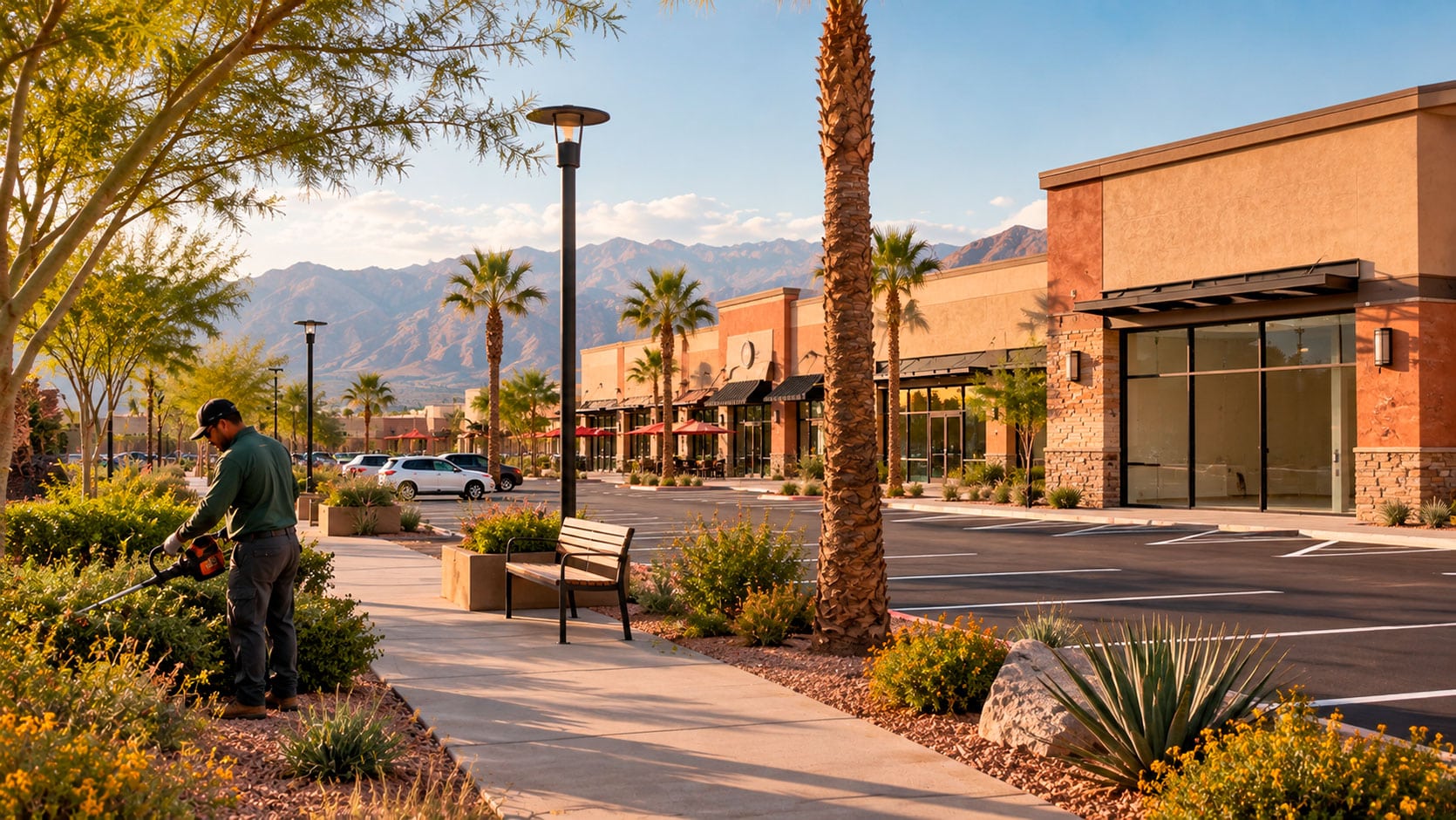
https://ramgrouplv.com/wp-content/uploads/2026/10/Commercial_Desert_View.jpg 945 1675 Michael Torres https://ramgrouplv.com/wp-content/uploads/2019/06/ram-logo-new.jpg Michael Torres2026-10-12 11:31:482026-10-12 11:31:48What Class A Office Space Really Costs in Las Vegas: Rent, Operating Expenses, TI and Parking

Categories

  • Latest News – Updates & Insights
  • News – Recent Updates & Articles

Archives

  • October 2026
  • July 2026
  • June 2026
  • May 2026
  • April 2026
  • March 2026
  • February 2026
  • January 2026
  • December 2025
  • October 2025
  • July 2025
  • April 2025
  • March 2025
  • February 2025
  • January 2025
  • August 2024
  • July 2024
  • June 2024
  • July 2021
  • June 2021
  • May 2021
  • April 2021
  • March 2021
  • February 2021
  • January 2021
  • December 2020
  • November 2020
  • August 2020
  • July 2020
  • June 2020
  • May 2020
  • April 2020
  • March 2020
  • February 2020
  • January 2020
  • December 2019
  • November 2019
  • October 2019
  • August 2019
  • July 2019
  • June 2019
  • October 2018
  • January 2017
  • September 2016
  • August 2016
Real Estate Asset Management

RAM Real Estate Asset Management

Contact:
C. 702.768.6960
O. 702-363-4788
E. tannersusa@gmail.com
E. info@ramgrouplv.com
Address:
3275 S Jones Blvd Suite 105
Las Vegas NV 89146
© 2026 RAM Real Estate Asset Management. All Rights Reserved
Website Development by Once Interactive
Scroll to top Scroll to top Scroll to top